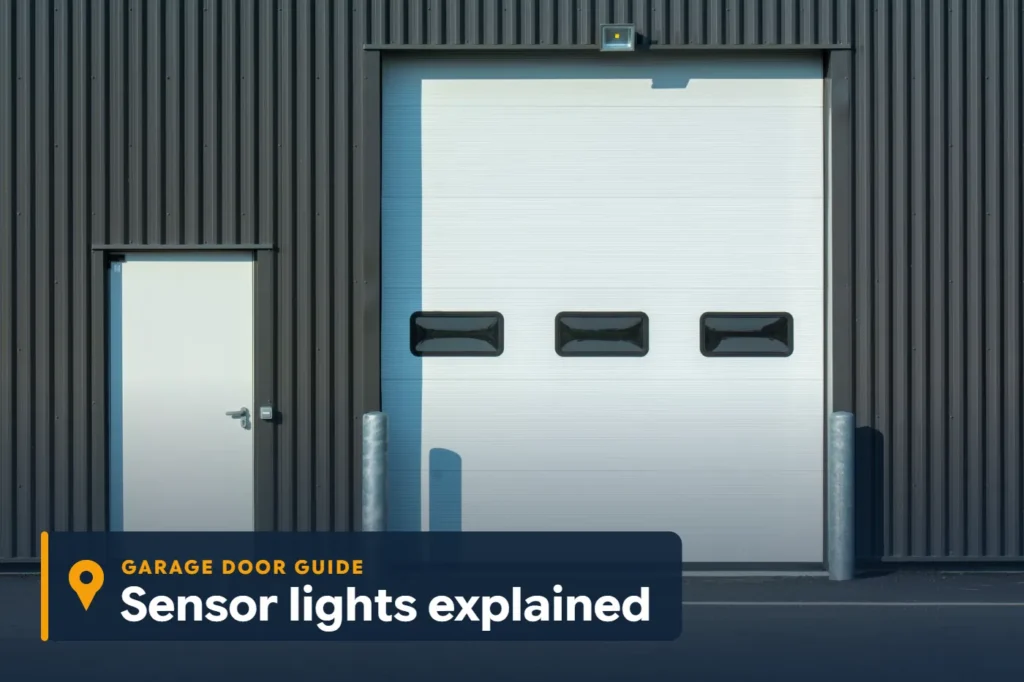
The two small boxes near the bottom of your garage door tracks are photo-eye safety sensors. They are the reason a closing door stops and reverses if a child, pet or car is in the way, and they are the most common reason a door suddenly refuses to close. Their little indicator lights tell you what is wrong, once you know how to read them.
How the sensors work
One sensor sends an invisible infrared beam across the doorway; the other receives it. While the door closes, the opener watches that beam. If the beam is broken, it stops and reverses. US openers have been required to have this type of protection since 1993.
What the lights usually mean
Colors differ by brand and model, so check your manual, but on most residential openers:
| What you see | Usual meaning |
|---|---|
| Both lights steady | Sensors powered and aligned. If the door still won’t close, look elsewhere. |
| Sending light on, receiving light off | The beam isn’t reaching the receiver: misaligned, dirty lens or something in the way. |
| Receiving light flickering or dim | Alignment is borderline, or bright sun is hitting the lens. |
| Both lights off | No power to the sensors: a cut or loose wire, or a fault at the opener terminals. |
| Opener light blinking after the door reverses | The opener is reporting a sensor problem. On many LiftMaster and Chamberlain models this is about ten flashes. |
On many LiftMaster and Chamberlain models, the sending sensor shows amber and the receiving sensor shows green. Other brands use different colors, so treat “one light steady, one light off” as the key pattern rather than the exact color.
Five-minute fixes
- Clear the doorway. Bins, hoses, boxes, even a hanging cobweb can break the beam.
- Clean both lenses with a soft, dry cloth. After a Phoenix dust storm this fixes a large share of calls.
- Realign. Loosen the wing nut, slowly move the receiving sensor until its light is steady, then tighten. Both sensors should point straight at each other at the same height.
- Block the sun. Low afternoon sun on a west-facing garage can blind the receiver. A small shade over the lens, or swapping the sender and receiver sides, solves it.
- Check the wires from each sensor to the opener for staples, cuts or chewed sections.
When to call a technician
If the lights stay off after you check the wire, if a sensor is cracked, or if the lights look normal but the door still reverses, the problem is a failed sensor, damaged wiring or opener settings. See garage door sensor repair in Phoenix. For the bigger picture of a door that won’t close, read Garage door won’t close and the light is blinking.
Never bypass the sensors
Taping sensors together or mounting them high defeats the safety system. To close the door once in an emergency, press and hold the wall button until the door is fully down. Then get the sensors fixed.
Frequently asked questions
Why is one garage door sensor light green and the other yellow?
On many openers that is normal: one light shows the sending sensor is powered and the other shows the receiver sees the beam.
Why does my garage door sensor light keep blinking?
Usually the beam is only partly reaching the receiver because of slight misalignment, a dirty lens or sun glare.
Can heat damage garage door sensors?
Yes. Years of high garage temperatures and direct sun can degrade sensor electronics and wiring insulation.
Door still won’t close? Call (602) 848-8510 and describe what the door is doing. Your call is connected to a local garage door technician in Phoenix or your Valley city, who confirms the price before any work starts.